


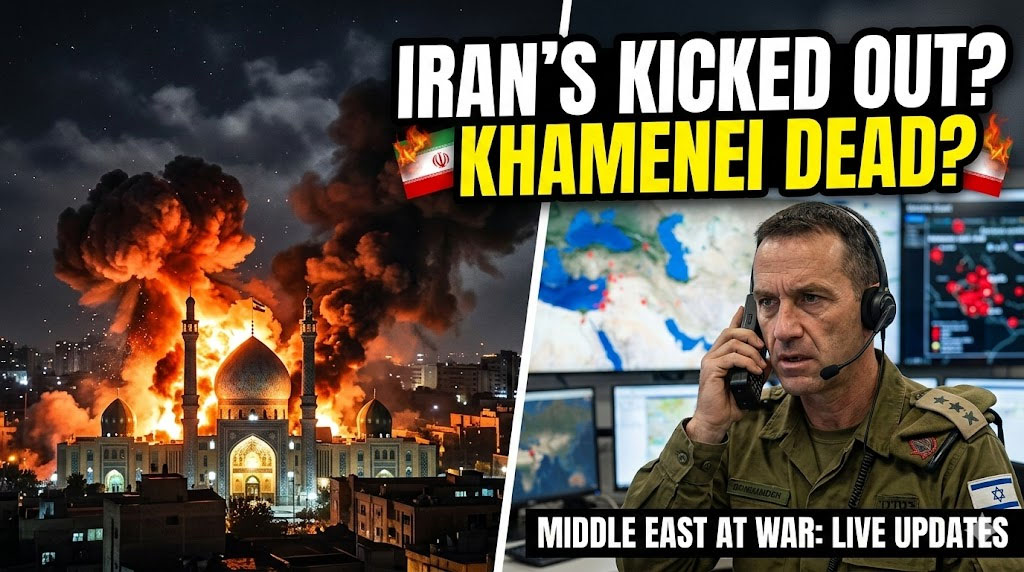
Iran-Israel war update today : The geopolitical maps of the Middle East are being redrawn in real-time. Following weeks of intensifying skirmishes, the regional “shadow war” between Israel and Iran has exploded into a direct, full-scale confrontation. The spark that ignited this global firestorm was a massive joint strike by the U.S. and Israeli forces, which resulted in the death of Iran’s long-standing Supreme Leader, Ayatollah Ali Khamenei.
The Death of an Era: Khamenei’s Passing and the Power Vacuum
On the morning of March 1, 2026, Iranian state media confirmed the news that had been circulating in hushed tones across intelligence circles: Ayatollah Ali Khamenei is dead. Reports indicate he was killed during a strike on his high-security compound in Tehran.
Khamenei, who had ruled Iran since 1989, was the ultimate authority on all state matters, from nuclear policy to regional proxy wars. His death leaves a massive void at the heart of the Islamic Republic. Under Article 131 of the Iranian Constitution, a transitional council consisting of the President, the Head of the Judiciary, and the Speaker of Parliament has temporarily assumed leadership. However, with the country under active bombardment, the question of a permanent successor remains a flashpoint for potential internal collapse or a hardline military takeover by the Islamic Revolutionary Guard Corps (IRGC).
“Operation Epic Fury”: The U.S. and Israeli Offensive
The military operation, reportedly codenamed “Epic Fury,” was a response to Iran’s advancing nuclear program and its alleged involvement in a series of destabilizing strikes against global shipping and regional allies earlier in the year.
- Targeted Strikes: Israeli Defense Forces (IDF) have confirmed “wave after wave” of strikes targeting ballistic missile sites, drone factories, and air defense systems across Iran.
- U.S. Involvement: President Donald Trump, in a stern address from the White House, confirmed U.S. participation, stating the goal was to “neutralize the world’s leading state sponsor of terror” and offering the Iranian people a chance to “take back their destiny.”
- Retaliation: Iran has not remained silent. The IRGC launched a massive salvo of missiles toward Tel Aviv and Haifa, as well as U.S. military installations in the UAE, Qatar, and Bahrain.

Global Chaos: Airspace Closures and Economic Shockwaves
The immediate fallout of the conflict has been felt most acutely in the aviation and energy sectors. The Middle East, a primary hub for global transit, has seen a near-total shutdown of civilian flight paths.
Aviation Crisis
Major carriers including Emirates, Qatar Airways, Air India, and Lufthansa have suspended all flights to the Persian Gulf. International flights are being rerouted over Central Asia or the Horn of Africa, adding up to six hours of travel time and millions in additional fuel costs. Airports in Dubai, Abu Dhabi, and Tel Aviv are currently operating under emergency protocols or remain closed to commercial traffic.
The Oil Factor and the Strait of Hormuz
The most significant threat to the U.S. and global economy is the potential closure of the Strait of Hormuz. Nearly 20% of the world’s oil passes through this narrow waterway. Iran has historically threatened to mine the strait in the event of a full-scale war. If shipping is halted, analysts predict oil prices could skyrocket past $150 per barrel, triggering a global inflationary spiral just as the U.S. enters a critical midterm election cycle.
What Happens Next? Three Potential Scenarios
The coming days will determine whether this conflict remains a localized “regime-change” operation or devolves into World War III.
- The Internal Collapse: With the Supreme Leader gone and the military infrastructure battered, internal dissent in Iran—fueled by years of economic hardship—could lead to a popular uprising, effectively ending the 1979 Islamic Revolution’s grip on power.
- The Regional Firestorm: If Iran’s proxies (Hezbollah in Lebanon, Houthis in Yemen, and militias in Iraq) launch a coordinated “Ring of Fire” attack against Israel and U.S. interests, the entire region could be engulfed in a decade-long war.
- Diplomatic Intervention: While the U.S. has currently abandoned the nuclear negotiating table, global powers like China and Russia may attempt to broker a ceasefire to prevent a total energy collapse, though their influence over the current Trump administration appears limited.
FAQs : War Highlights
The Core Event
- Death of Supreme Leader: Iranian state media officially confirms the death of Ayatollah Ali Khamenei, marking the end of a three-decade era.
- Operation Epic Fury: The U.S. and Israel have launched a massive, coordinated military operation, dubbed “Operation Epic Fury,” aimed at neutralizing Iran’s military infrastructure.
- Power Vacuum: Following Khamenei’s death, a transitional council is struggling to maintain order amid ongoing airstrikes.
- Trump’s Stance: U.S. President Donald Trump has officially endorsed the operation, calling it a “historic opportunity” for the Iranian people to reclaim their country.
- Regime Change Objective: Military analysts suggest that the primary goal of the current campaign is not just deterrence, but a fundamental change in Tehran’s leadership.
Military Escalation
- Wave of Strikes: Multiple waves of airstrikes have crippled Iran’s ballistic missile launch sites and air defense systems across Tehran, Isfahan, and Tabriz.
- Retaliatory Fire: Iran has responded by launching a barrage of missiles toward Tel Aviv and Haifa, as well as U.S. bases in Qatar, Bahrain, and the UAE.
- U.S. Military Buildup: The U.S. has deployed two carrier strike groups and F-22 jets, the largest mobilization in the region since 2003.
- Emergency Alerts: The UAE and other Gulf nations have issued urgent “seek shelter” alerts to millions of residents due to incoming missile threats.
- Targeting Leadership: Reports indicate that besides the Supreme Leader, significant portions of the IRGC senior leadership have been neutralized.
Global Impact & Economics
- Oil Prices Spike: Energy markets are in a tailspin; oil prices are projected to surge beyond $150 per barrel if the conflict persists.
- Strait of Hormuz Alert: The world is watching the Strait of Hormuz—the most critical oil transit chokepoint—as shipping faces an existential threat.
- Aviation Shutdown: Major international airlines have suspended all flights over the Persian Gulf, causing massive disruptions to global travel.
- Global Inflation Fears: Economists warn that a prolonged conflict will trigger a global inflationary spiral and supply chain crises.
- Energy Security: Nations dependent on Middle Eastern oil are scrambling to secure alternative supply routes as regional exports slow down.
Geopolitical Future
- Axis of Resistance: The death of Khamenei potentially dismantles the “Axis of Resistance,” leaving Iran-backed groups like Hezbollah and militias in Iraq in a state of confusion.
- Regional Firestorm: Experts worry that the conflict could expand into a “Ring of Fire” scenario, pulling neighboring nations into a direct regional war.
- Diplomatic Isolation: Iran’s aggressive retaliatory strikes have isolated it from its remaining regional neighbors, who have called for a cessation of hostilities.
- Internal Unrest: With the regime weakened, internal protests and civil unrest are rising, creating a volatile domestic situation in Iran.
- Security Council Emergency: The UN Security Council has held an emergency meeting to address the violations of sovereignty and the threat to global peace.









Leave a Reply