


By MarketDesk – February 23, 2026
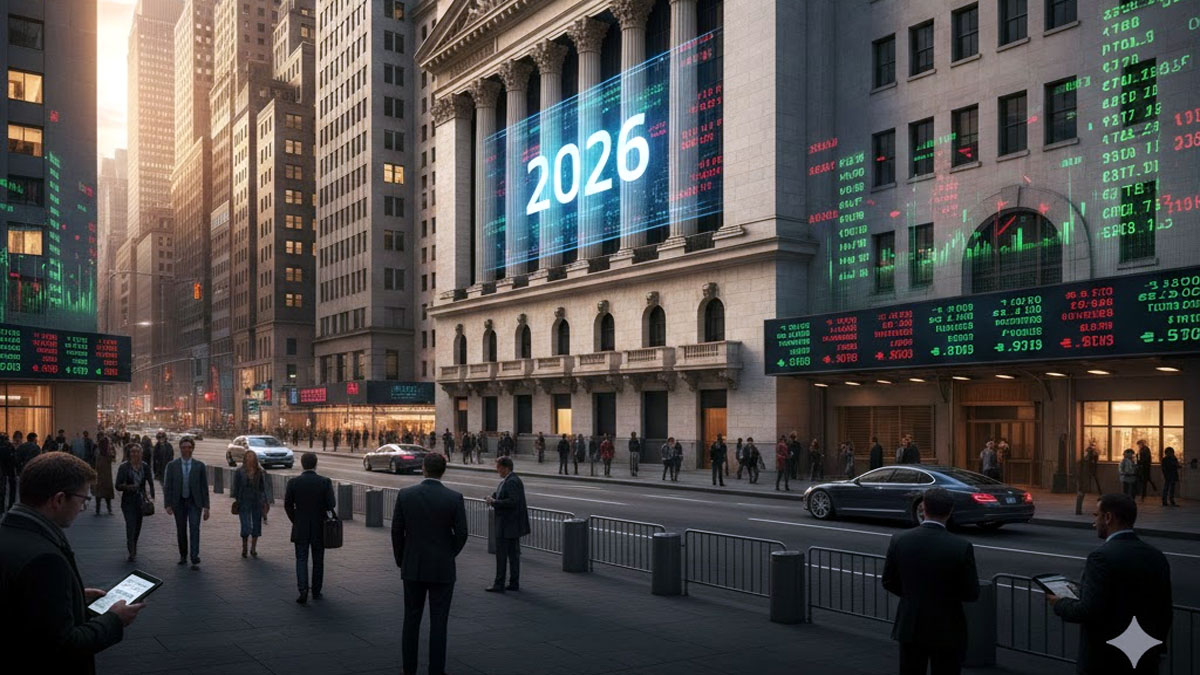
US Stock Market Update 2026 : The 2026 US stock market landscape continues to evolve under a complex confluence of economic data, geopolitical developments, lofty valuations, and investor sentiment that has swung between optimism and caution in the first months of the year.
While some benchmarks celebrate all‑time highs, others grapple with bearish signals and headwinds from trade policy and global capital flows.
Here’s a detailed and up‑to‑the‑minute review of how the major US indices are faring, what’s driving market dynamics, and where analysts see the road ahead.
1. Market Performance Snapshot: Mixed Signals Across Benchmarks
The major US indices have shown mixed performance in early 2026:
- S&P 500: Hovering around record levels, though recent sessions have shown subdued movement as investors react to conflicting economic data and political uncertainty.
- Dow Jones Industrial Average: Witnessed a historic moment earlier in the year, briefly crossing 50,000 points — a psychological milestone that underscored ongoing bullish resilience.
- Nasdaq Composite: Tech‑heavy and sentiment‑sensitive, it’s seen periodic sell‑offs amid profit‑taking and risk‑off flows.
Daily trading typically reflects narrow ranges, with overall volatility heightened by macroeconomic headlines and policy shifts.
This ambivalence — markets neither definitively breaking out nor collapsing — marks much of the first quarter of 2026.
2. Trade Policy and Tariff Headlines Spark Market Reaction
One of the defining narratives shaping the markets in early 2026 has been trade policy.
In a dramatic development this week:
- News reports show U.S. tariffs reintroduced on global trading partners, based on broad authority from 1970s legislation. This triggered a sell‑off in equities and a safe‑haven rally in gold.
- U.S. stock futures dipped and the Dollar weakened, while markets — both domestic and international — responded with caution.
Investors are digesting these policy risks alongside inflation data and geopolitical uncertainty, leading to sometimes choppy trading sessions rather than sustained uptrends.
3. Global Market Flows: Capital Shifting Away from US Equities
A recent market report highlighted a notable trend:
U.S. equity funds are experiencing substantial outflows, with nearly $75 billion leaving domestic equities so far in 2026.
This trend suggests:
- Greater attractiveness of international markets
- Rising concerns about valuations at home
- Portfolio rebalancing toward ex‑US growth opportunities
If sustained, these outflows could challenge the long‑standing perception of US stocks as the default global growth engine.
4. Valuations & Overvaluation Concerns: Buffett Indicator Signals Caution
Wall Street’s dour side has been amplified by valuation metrics that show the market trading at historically high levels relative to economic output.
The Warren Buffett Indicator — a measure comparing total market cap to GDP — currently sits well above historical norms, a red flag for some strategists.
What this means for investors:
- Markets may be overvalued, increasing risks of a correction
- The high ratio invites comparisons to prior periods before major downturns
- Short‑term traders are pricing in modest odds of deeper pullbacks later this year.
It’s important to note that a high valuation doesn’t guarantee a crash — but it does underscore heightened risk perceptions among institutional players.
5. Earnings & Sector Dynamics: Tech Reigns, But Breadth is Improving
Despite volatility, corporate earnings still tell a story of resilience:
- A recent earnings season showed double‑digit year‑over‑year earnings growth, particularly in technology.
Tech stocks, especially names tied to AI adoption and cloud growth, have broadly outperformed cyclical sectors.
However, institutional outlooks from firms like Goldman Sachs forecast a broadening of leadership in 2026 — suggesting more industries may start contributing to market gains beyond the big tech cohort.
This may indicate a healthier, more diversified market if sustained.
6. Economic Data and Market Drivers: Growth Slows, Inflation Lingers
Recent GDP and inflation data have provided mixed signals:
- U.S. GDP growth slowed in late 2025 to around 1.4%, lower than expectations.
- Core inflation metrics remain somewhat elevated, keeping the Federal Reserve’s policy outlook in focus.
Markets are now balancing hopes of future rate cuts against concerns that growth may be weakening faster than expected.
This dynamic is one reason stocks have oscillated — traders are torn between bullish monetarist bets and cautious economic readings.
7. Investor Sentiment: From Caution to Opportunity
Investor sentiment has been swinging:
- Some traders express caution due to political policy risks, including tariffs and regulation uncertainty.
- Others remain optimistic based on earnings resilience and growth forecasts.
Several prediction markets now reflect a roughly 58% probability of a market correction by year‑end — a notable sentiment signal.
This blend of fear and optimism is typical of markets priced at historically high levels with mixed fundamental signals.
8. What Analysts Are Watching Next
Wall Street analysts and strategists are keenly focused on these key catalysts:
Interest Rate Outlook
Expectations around future interest rates — and potential Fed pivots — will be central.
Trade & Policy Clarity
Any shifts in trade or fiscal policy could recalibrate market risk premiums.
Earnings Surprises
Corporate results that beat or miss forecasts will drive short‑term volatility.
Global Growth Trends
Capital flows to international markets may continue if returns abroad outpace U.S. equities.
9. Looking Ahead: Navigating 2026’s Market Terrain
As 2026 unfolds, the US stock market’s story is not one of unbridled gains nor outright collapse — but of nuanced recalibration.
Global investors are rethinking long‑held assumptions about US market leadership. Geopolitical developments and valuation concerns are adding complexity to decision‑making.
However, earnings trends and some prominent forecasts from major investment banks still point to potential gains by year‑end — albeit with sharper volatility than recent bull markets.
Ultimately, 2026 may prove to be a year where valuation discipline, macroeconomic awareness, and sector rotation define success for investors navigating Wall Street’s shifting tides.
If you’d like, I can also provide a graphic or table summarizing index performance or a timeline of major policy events affecting markets in 2026.









Leave a Reply